
Stained Glass of Percy Bacon & Brothers
- Home
- Life
- UK County List
- Bedfordshire
- Berkshire
- Bristol
- Buckinghamshire
- Cambridgeshire
- Cornwall
- Cumbria
- Derbyshire
- Devon
- Dorset
- Dumfries & Galloway
- Durham
- East Sussex
- Essex
- Gloucestershire
- Gtr Manchester
- Hampshire
- Herefordshire
- Hertfordshire
- Kent
- Leicestershire
- Lincolnshire
- Gtr London
- Barnes:
St Michael - Camden:
St James † - City: St Dunstan-in-the-West
- Clapton,
Christ Church† - Croydon: Woodcote
- Ealing:
Christ Church† - Ealing: St Saviour†
- Hammersmith
St Paul - Hornchurch
- Little Ilford
- Islington, St Paul†
- Kensington:
St John the Baptist - Mortlake:
St Mary Mag, RC - Perry Hill,
St George† - Roehampton
- Romford, St Edward the Confessor
- Staines
- Twickenham,
St Stephen - Upminster,
St Laurence - Upton Cross,
St Peter† - Woolwich Garrison†
- Woolwich:
St Michael - Yiewsley
- Barnes:
- Midlothian
- Merseyside
- Norfolk
- North Yorkshire
- Northamptonshire
- Northern Ireland
- Northumberland
- Nottinghamshire
- Oxfordshire
- Pembrokeshire
- Rutland
- South Yorkshire
- Somerset
- Suffolk
- Surrey
- Tyne & Wear
- Warwickshire
- West Sussex
- Wiltshire
- Worcestershire
- Non UK
- Gazetteer
- Contact
- Essays
- Lost Work

St Mary's lies in a peaceful valley within the Cranborne Chase area. A small church, well presented. It contains a rare and unusual Easter sepulchre, installed around the early sixteenth century by Thomas Weaver, a wealthy cleric. He was also responsible for substantial extensions to the north side of the church. The sepulchre consists of an arched blind recess in the north wall with carved angels to either side, somewhat defaced now. The church was built c14th, with a tower and cleretorey added c15th. Nave tower and porch are embattled, exuding an air of strength and solidity to the little church. Chancel largely rebuilt in 1874 by Banjamin Ferry.1
Aside form the single Percy Bacon window in the church, there is a fine millenium window by contemporary artist Thomas Denny, Based on Joel Ch2, V 21-27, the window explores the "gladness of the land" reflecting the chalk landscape in which the village lies.
St Mary's is well worth the detour.
Posted 14 August 2022.


The use of white glass and a single colour of yellow stain makes this a very unusual, and possibly unique work by Percy Bacon & Brothers. The window of three lights, installed in 1909,2 depicts three standing figures of saints associated with the Kingdom of Wessex, one per light; St Birnius, St Edward Rex, and St Aldhelm. Above each respectively the arms of Winchester, Shaftsbury and Salisbury. In the tracery, simple floral motifs.
On a brass plaque below, the window is dedicated to the memory of Charles Bugg (d. 13 March 1909), churchwarden. Placed by his widow. "The Lord will be merciful to them that try to do their duty".
The church guide reads; "The stained glass window of the south aisle was the first of a projected series showing ecclesiastical history of Wessex" (see below).

The window is signed bottom right; "Percy Bacon & Bro. 11 Newman St. London W". Note the singular, "Bro".

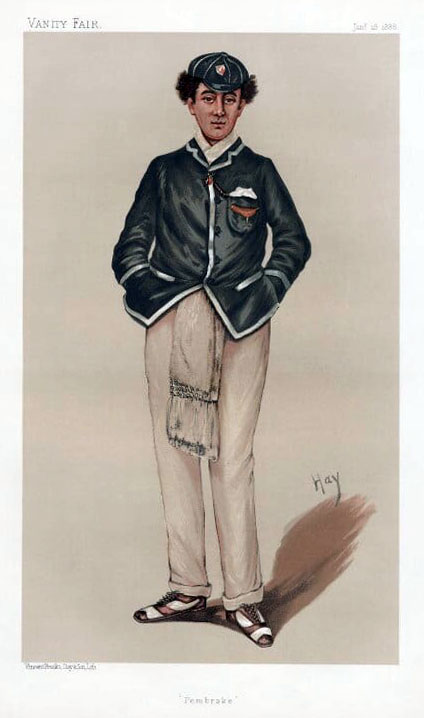
Portrait of the Rev. Ernest Heriz-Smith published in Vanity Fair
in 1888. Image courtesy of the National Portrait Gallery.
Posted 02 November 2026.
Further light on the choice of the subject matter in the Percy Bacon window is shed by an interesting article by T. P. Connor, published in the Proceeding of the Dorset Natural History and Archaeological Society in 2019.2 The window is only a very small part of a much more extensive scheme designed by the Rector, Ernest John Heriz-Smith (1851-1911). Heriz-Smith had been appointed to the living St Mary’s, Tarrant Hinton, as a result of a minor scandal in Cambridge. In 1896 he had been accused of founding a “Secret Society”, one which opponents characterised as Popish, “…. a much larger danger to the Church of England in which, they felt, ‘that some who have taken orders in the Anglican Church are in reality doing the work of Rome’”.3 The Rev Heriz-Smith had been elected fellow of Pembroke College, Cambridge in 1875,4 and to Pembroke this scandal proved too much. The living of Tarrant Hinton had come into the possession of Pembroke College not long before the scandal broke, and its senate, which thought it best to, “take cognisance of the matter”,5 took the chance to quietly make the problem go away, and offered this far-flung post to Heriz-Smith, likely as not to forestall any further embarrassment.
Accepting the offer, Heriz-Smith drew up an extensive and elaborated design to beautify his new church. What we know of the scheme is contained in numerous correspondences between Heriz-Smith and eminent church architects, including Charles Ponting, the diocesan architect, Mary Lowndes, the stained glass artist, and other craftsmen. As well as a complete reglazing of the entire church (perhaps the most ambitious part of the scheme), plans were drawn up for a new high altar and reredos, altar rails, new floors and seating, wall paintings, numerous statues, including a rood scene in the Easter Sepulchre, and possibly an upper floor in the west of the north aisle to form a choir loft. The scheme for the windows is detailed in a surviving page from The Tarrant Magazine, enigmatically entitled, “The Dream of Tarrant Hinton – A Picture Book of Dorset Church History”. The proposed subject matter in each of the windows in the church is described, and would have been a chronological pageant of Dorset ecclesiastical worthies spanning a thousand years, from Anglo-Saxon saints to contemporary Bishops, and even a recently deceased churchwarden, presumably added later. Heriz-Smith proposed that only the windows in the chancel (the preserve of the Patron, Pembroke College) were to be coloured. The rest were to be, “in white, black brown, and gold, after S. Nicholas, S. Urbain, and S. Pantaleos at Troyes [France], recommended by G. G Scott R.A.”
Alas the greater majority of the scheme was never started, but the reverend’s desire for a specific 16th century style for the nave windows was faithfully executed in the one window in the south aisle which was completed, that by Percy Bacon. It also explains the unusual nature of this work in the Bacon corpus. Although the churchwarden, Charles Bugg, was never honoured with a representation of him in a window, he is remembered in the dedication in the Percy Bacon window. Charles Bugg farmed a large area of land at Manor and North Farms, and died childless in October 1908 with an estate worth in excess of £35,000. It was likely his executors who paid for the window. This might also explain why the Reverend Smith’s scheme was never advanced. Quite simply lack of funds. He died in March 1911 with an estate valued at just £1,500.
References: Use your browser's Back button to return to text.
- British History Online: Tarrant Hinton.

- Randall, Dr. C. (Ed). Proceeding of the Dorset Natural History and Archaeological Society, Vol 140, 2019, pp12-19. 'A Dream of Tarrant Hinton' - A Dorset pageant in stained glass by T.P. Connor.
- The Times 7 April 1896.
- Illustrated London News, 5 June 1875.
- Yorkshire Post, 10 April 1896.
Location Map:
Sat Nav Post Code: DT11 8JB